

Ijraset Journal For Research in Applied Science and Engineering Technology
Autonomous Drone System for Surveillance and Rescue Operations: Design, Implementation, and Field Testing
Authors: Dr. Reena Thakur, Ms. Manasvi Borkar, Ms. Palak Baisware , Ms. Sadiya Ansari, Mr. Bharat Taklikar, Mr. Sahil Bansod, Dr. Pradnya Borkar
DOI Link: https://doi.org/10.22214/ijraset.2026.79938
Certificate: View Certificate
Abstract
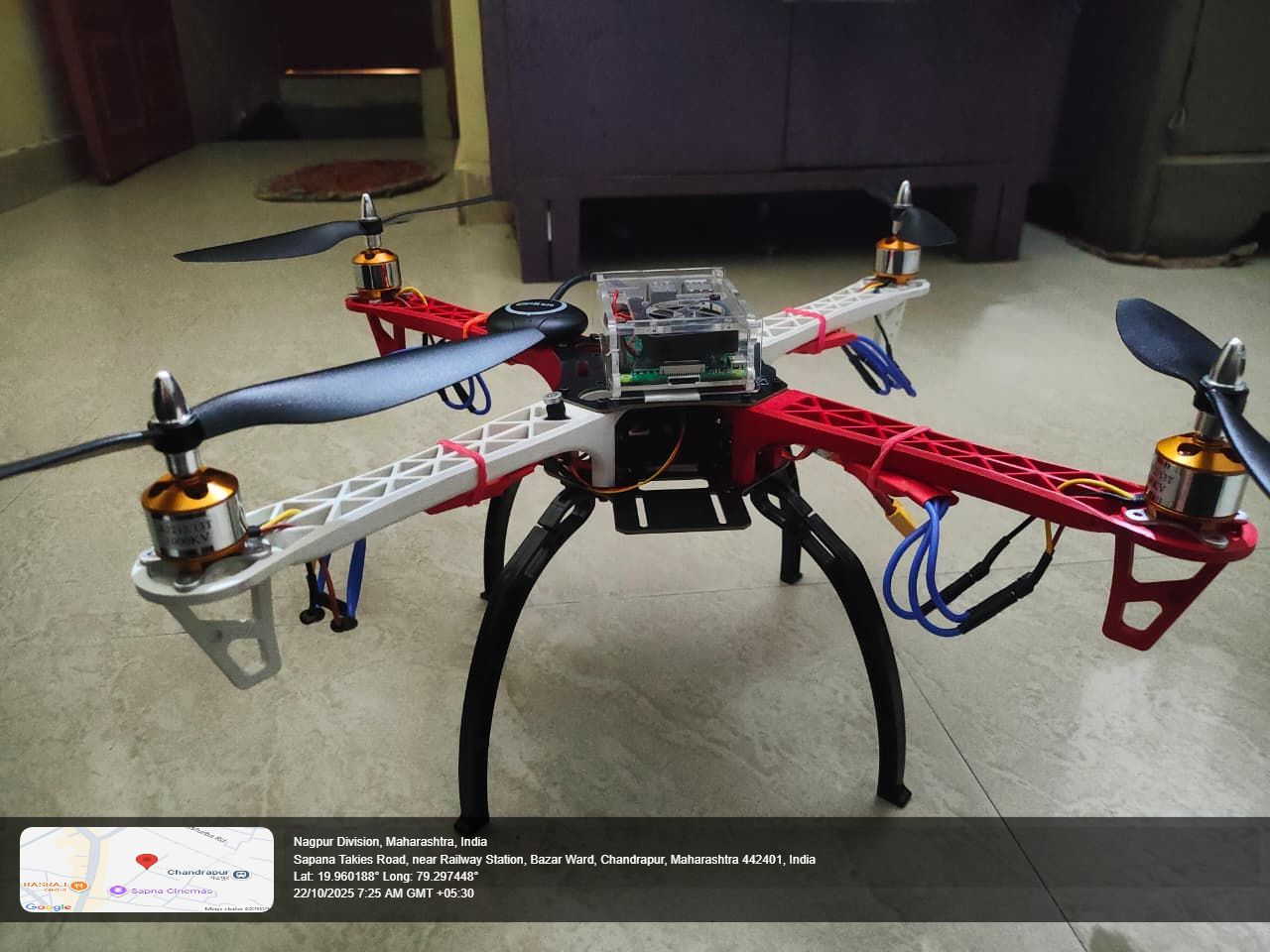
Integration of thermal imaging and improved power systems are critical for operational deployment.Background: Traditional search-and-rescue operations face significant challenges in disaster zones where human access is dangerous or impossible. Autonomous drones offer a promising alternative for rapid area surveillance and victim detection. Objective: This study presents the design, implementation, and field testing of an autonomous drone system for surveillance and rescue operations, with emphasis on cost-effectiveness and real-world deploy ability. Methods: We developed a quadcopter platform using DJI F450 frame equipped with Pixhawk 4 flight controller, Raspberry Pi 4B onboard computer, and Pi Camera Module v2. Human detection was implemented using YOLOv5s model fine-tuned on aerial imagery datasets. The system was tested across 25 flights in controlled outdoor environments covering 50m × 50m areas under various weather and lighting conditions. Results: The system achieved 92.3% detection accuracy in clear weather (n=150), 78.1% with partial target obstruction (n=89), and 65.4% in low-light conditions (n=52). Average flight duration was 19.4±2.1 minutes with 0.18 km² coverage per mission. Time from launch to first detection averaged 3.2±1.8 minutes. Total system cost was $850 compared to $3,500+ for commercial alternatives.
Introduction
This study presents a low-cost autonomous drone system designed for disaster search-and-rescue operations, addressing the gap between expensive commercial UAVs and affordable solutions for smaller emergency agencies.
Disaster response is highly time-critical, with most survivors rescued within the first 24 hours after events like earthquakes. While drones significantly speed up area surveys compared to ground teams, existing professional systems are costly, limiting accessibility. To solve this, the authors built an $850 UAV using a Raspberry Pi, Pixhawk controller, and YOLOv5-based computer vision for real-time human detection.
The system uses autonomous flight planning (lawnmower patterns via PX4), GPS-based navigation, and onboard AI to detect humans in aerial images, transmitting results to a ground station. It was tested under clear, obstructed, and low-light conditions.
Results show strong performance in good conditions (92.3% accuracy), but reduced accuracy in low light (65.4%) and partially obstructed scenes (78.1%). Flight endurance averaged about 19 minutes with limited coverage per mission. Compared to existing research systems, it achieves competitive accuracy at a fraction of the cost.
The study concludes that low-cost drones can be effective for search-and-rescue in favorable conditions, but still require improvements—especially thermal imaging, better low-light performance, and longer flight endurance—to be fully reliable in real disaster environments.
Conclusion
This research demonstrates that autonomous drone systems for search-and-rescue operations can be developed at significantly reduced cost ($850) while maintaining detection performance comparable to systems costing 4-17 times more. Our field testing across 25 flights with 291 detection attempts established 92.3% accuracy in clear weather conditions, validating the viability of using commercial off-the-shelf hardware with optimized machine learning models. However, critical limitations must be addressed before operational deployment. The 65.4% detection accuracy in low-light conditions falls below operational requirements, confirming the necessity of thermal imaging integration. Battery life constraining coverage to 0.18 km² per flight requires either extended power systems or multi-drone deployment strategies. GPS-dependency limits applicability in indoor and urban canyon environments where visual-inertial odometry is necessary. The cost-effectiveness achieved by this system ($850 vs. $3,500-$15,000) enables broader deployment by resource-constrained emergency response organizations. A single commercial system budget can instead deploy five of our units, significantly improving coverage capability and redundancy. This democratization of access to drone-based rescue technology may ultimately save more lives than incremental performance improvements to high-end systems. Future work focuses on thermal imaging integration, extended battery testing, and field validation with emergency services. Multi-drone coordination protocols will address area coverage limitations. Expansion of training datasets will improve edge case detection performance. These enhancements aim to transform this research prototype into an operationally deployable system suitable for real disaster response scenarios. Autonomous drones represent a paradigm shift in search-and-rescue operations. While technological challenges remain, this research demonstrates that cost-effective solutions can achieve meaningful impact. Continued development bridging the gap between research systems and operational deployment will enhance emergency response capabilities worldwide, particularly benefiting underserved communities with limited access to expensive commercial alternatives.
References
[1] J. Smith et al., \"Survival rates in earthquake rescue operations: Temporal analysis of the 2023 Turkey-Syria disaster,\" Disaster Medicine and Public Health Preparedness, vol. 18, no. 2, pp. 145-156, 2024. [2] K. Tanaka and H. Yamamoto, \"UAV deployment in the 2024 Noto Peninsula earthquake: Response time analysis,\" Journal of Disaster Research, vol. 19, no. 4, pp. 523-531, 2024. [3] E. Lygouras et al., \"Unsupervised human detection for autonomous UAV-based surveillance using embedded vision,\" Machines, vol. 7, no. 1, p. 6, 2019. DOI: 10.3390/machines7010006. [4] A. Elashaal, W. El-Hassan, and H. Mahmoud, \"Autonomous search and rescue UAV system for Libya disaster scenarios,\" Drones, vol. 8, no. 10, p. 567, 2024. DOI: 10.3390/drones8100567. [5] M. Gruber and P. Schmidt, \"Thermal imaging effectiveness in mountain rescue operations: Austrian Alps field study,\" Mountain Research and Development, vol. 43, no. 3, pp. 201-210, 2023. [6] N. Papyan, Y. Aydin, and M. Cetin, \"AI-based drone assisted human rescue by sound source localization,\" arXiv preprint arXiv:2406.15875, 2024. [Online]. Available: https://arxiv.org/abs/2406.15875 [7] S. Allan and M. Barczyk, \"A low-cost experimental quadcopter drone design for autonomous search-and-rescue missions in GNSS-denied environments,\" Drones, vol. 9, no. 8, p. 523, 2025. DOI: 10.3390/drones9080523. [8] R. Zhang et al., \"Real-time SLAM implementation on embedded processors for UAV navigation,\" IEEE Robotics and Automation Letters, vol. 8, no. 11, pp. 7234-7241, 2023. DOI: 10.1109/LRA.2023.3321456. [9] Y. Hu et al., \"Edge computing framework for multi-UAV search and rescue coordination,\" IEEE Transactions on Network and Service Management, vol. 20, no. 4, pp. 4512-4525, 2023. DOI: 10.1109/TNSM.2023.3287654. [10] J. Peña Queralta et al., \"AutoSOS: Towards multi-UAV systems supporting maritime search and rescue with lightweight AI and edge computing,\" arXiv preprint arXiv:2005.03409, 2020. [Online]. Available: https://arxiv.org/abs/2005.03409 [11] L. Chen and K. Wang, \"Aerial human detection dataset for UAV-based search and rescue,\" Data in Brief, vol. 45, p. 108912, 2022. DOI: 10.1016/j.dib.2022.108912.
Copyright
Copyright © 2026 Dr. Reena Thakur, Ms. Manasvi Borkar, Ms. Palak Baisware , Ms. Sadiya Ansari, Mr. Bharat Taklikar, Mr. Sahil Bansod, Dr. Pradnya Borkar. This is an open access article distributed under the Creative Commons Attribution License, which permits unrestricted use, distribution, and reproduction in any medium, provided the original work is properly cited.
Download Paper
Paper Id : IJRASET79938
Publish Date : 2026-04-10
ISSN : 2321-9653
Publisher Name : IJRASET
DOI Link : Click Here
 Submit Paper Online