

Ijraset Journal For Research in Applied Science and Engineering Technology
Biomimetic Adaptive Facades: Optimizing Energy Efficiency through Natural Analogues
Authors: Aira Shet
DOI Link: https://doi.org/10.22214/ijraset.2026.77493
Certificate: View Certificate
Abstract
This study deals with how biomimetic adaptive facade designs can improve energy efficiency by replicating natural tactics. The study intends to create unique facade solutions that overcome both the issues of excessive energy consumption and environmental impact in buildings by analyzing the energy optimization strategies of natural systems. Cases of how biomimetic elements are used realistically include the Shanghai Tower, the Eastgate Center, and the St. Mary Axe Building. Using daylighting and passive natural ventilation techniques, the St. Mary Axe Building can save up to 50% on energy costs compared to traditional office buildings. The Eastgate Centre uses a passive cooling system that reduces dependency on conventional air conditioning, drawing inspiration from termite mounds. With sustainable facade technologies that maximize energy use and control wind loads in a high-rise setting, the Shanghai Tower is an excellent case of vertical urbanization. This study uses case study analysis, physical prototyping, and computer modelling to find essential biomimetic techniques that greatly enhance energy performance, such as ventilative cooling, dynamic insulation, and self- shading. The results offer innovative methods to minimize energy use while improving the quality of life in the built setting by integrating biomimetic adaptive facades into architectural design.
Introduction
Introduction: Evolution of Building Facades
Building facades have evolved from purely aesthetic or protective elements into active, climate-responsive systems. Traditional facade design relied heavily on passive strategies, often requiring large mechanical systems such as HVAC to maintain indoor comfort. The emergence of adaptive facades marks a shift toward building skins that dynamically respond to environmental factors like sunlight, wind, heat, and moisture, reducing reliance on mechanical systems.
A key advancement in this field is biomimicry—the practice of drawing inspiration from natural systems to solve complex design challenges. By mimicking nature’s strategies for temperature regulation, moisture control, and energy management, architects can create self-regulating building envelopes that improve energy efficiency and sustainability.
Biomimicry and Adaptive Facade Innovation
Biomimetic adaptive facades combine:
-
Smart materials (e.g., thermochromic materials, phase-change materials)
-
Sensors and automated control systems
-
Sustainable design strategies
These facades function like living organisms, adjusting to environmental changes. For example, thermochromic materials can change color with temperature, reducing solar heat gain in hot climates and maintaining thermal balance without mechanical intervention.
Research emphasizes that effective biomimetic design requires:
-
Clear identification of natural analogies
-
Integration of air, water, heat, and light regulation
-
Energy simulation and performance modeling
-
Use of renewable and passive solar strategies
Such approaches align with Nearly Zero Energy Building (NZEB) principles and contribute to reduced carbon emissions.
Case Studies
1. 30 St Mary Axe (The Gherkin), London


4
-
Uses spiraling light wells for natural ventilation
-
Double-glazed facade with solar-control systems
-
Operable panels act as the building’s “lungs”
-
Consumes about 50% less energy than conventional office buildings
-
Reduces CO? emissions by approximately 25%
The building integrates passive ventilation and daylight optimization to minimize artificial heating, cooling, and lighting.
2. Eastgate Centre, Zimbabwe


4
-
Inspired by termite mounds (biomimicry)
-
Uses passive cooling instead of conventional air conditioning
-
Incorporates shading, overhangs, and thermal mass
-
Regulates heat naturally through ventilation and material selection
This building demonstrates how biological inspiration can dramatically reduce mechanical cooling demands while maintaining comfort.
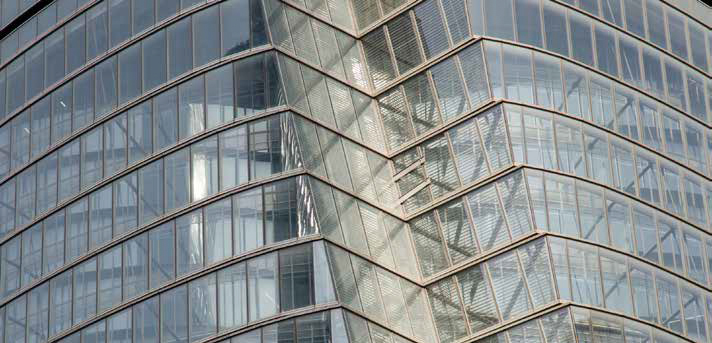
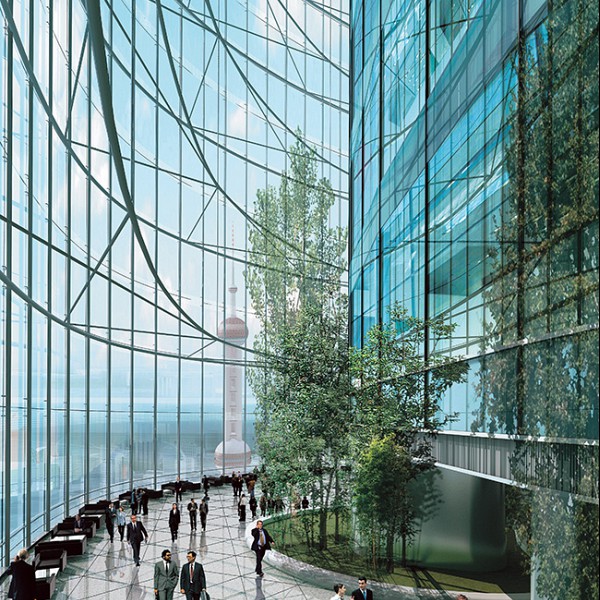
3. Shanghai Tower, China

4
-
Double-skin facade with internal and external glass layers
-
Aerodynamic twisting form reduces wind loads by 24%
-
Low-emissivity (Low-E) glass reduces heat transfer
-
Maximizes daylight penetration while minimizing overheating
The facade enhances energy efficiency by lowering reliance on mechanical systems and improving thermal performance.
Key Findings
-
Biomimetic adaptive facades regulate air, heat, water, and light.
-
Smart materials (e.g., aerogel insulation, phase-change materials, solar concentrators) improve energy performance.
-
Energy simulations are essential for validating facade efficiency.
-
Biomimicry contributes to reduced energy use, lower CO? emissions, and improved occupant comfort.
Conclusion
Biomimetic adaptive façades are revolutionizing the way energy-efficient buildings are conceptualized by looking into nature for inspiration. The Eastgate Centre in Harare is an example of a design based on termite mounds. It achieves natural methods of managing airflow and temperature, thereby lowering artificial cooling and energy use to a very substantial degree. This passive-cooling method saves money and the environment without losing effectiveness. Like this, London\'s 30 St. Mary Axe reduces the requirement for energy-heavy equipment as spiral atria work as natural ventilators. The aerodynamic, streamlined shapes cut wind resistance and allow an increased harmony with the environment, resulting in much more efficiency in buildings. This building stands out with its possibility of showing where sustainability and practicality meet in architecture inspired by nature. Like natural protective layers, the double skin of the Shanghai Tower allows natural light in and keeps the heat out. It would reduce the energy used in air conditioning and lighting. Its aerodynamic shape will help the environment by using less material and more in resisting wind. The skyscraper deals with practical or environmental problems while showing that biomimetic ideas work well in large city projects. The following examples demonstrate how biomimicry may assist in achieving ecological goals within modern architectural requirements and allow entry into a sustainable and energy-efficient building trend within cities.
References
[1] R. Sidhu and V. Singh, “Biomimicry for Developing Energy Efficient Facades.” Accessed: Nov. 25, 2024. [Online]. Available: https://ijirt.org/publishedpaper/IJIRT151150_PAPER.pdf [2] Deyaa, Wijdan & Jalil, Wijdan Deyaa Abdul. (2016). The Application of Biomimicry in Kinetic Facades. engineering. 22. 10.31026/j.eng.2016.10.08. [3] “Energy-Efficient facade and biomimicry in architecture,” https://dergipark.org.tr/en/download/article- file/1307381, 2016. https://dergipark.org.tr/en/download/article-file/1307381 (accessed Nov. 26, 2024). [4] N. P. R. Garcia, “The Influence of the Concepts of Biophilia and Biomimicry in Contemporary Architecture,” Journal of Civil Engineering and Architecture, vol. 11, no. 5, May 2017, doi: 10.17265/1934- 7359/2017.05.010. [5] J. Gargasas, K. Baziene, P. Dzienis, Vilnius Gediminas Technical University, and Bialystok University of Technology, “LOW ENERGY BUILDINGS: MULTIFUNCTIONAL STRATEGIES AND SOLUTIONS,” journal-article, Dec. 2023. [Online]. Available: https://pdfs.semanticscholar.org/8b94/4e044affba70a2370bb76d3551d809ed740d.pdf?_gl=1*1cf5ni1*_gcl_au* MTgzMzc4MDY2Mi4xNzI4OTE5Nzg1*_ga*NTMyNTg2MDg1LjE3Mjg5MTk3ODU.*_ga_H7P4ZT52H5*M TczMjU4MjM2Ni4zLjEuMTczMjU4NDUxNi41OS4wLjA. [6] A. Carpi and C. A. Brebbia, Design and Nature : Comparing Design in Nature with Science and Engineering. 2002. [Online]. Available: http://ci.nii.ac.jp/ncid/BA58820105 [7] R. Hyde, “Refining the principles of passive design,” Architectural Science Review, vol. 60, no. 5, pp. 357– 359, Aug. 2017, doi: 10.1080/00038628.2017.1368165. [8] P. Pintos, “30 St Mary Axe Tower / Foster + Partners,” ArchDaily, Nov. 12, 2019. https://www.archdaily.com/928285/30-st-mary-axe-tower-foster-plus-partners [9] “30 St Mary Axe, London, UK,” Urban Systems Design | MEP & Environmental Engineers. https://www.urbansystems.design/30-st-mary-axe-london-uk [10] R. T. Future, “Eastgate Center, Zimbabwe: A Marvel of Sustainable Architecture,” RTF | Rethinking The Future, Jan. 02, 2024. https://www.re-thinkingthefuture.com/articles/eastgate-center- zimbabwe/#google_vignette [11] K. Ansari, “Biomimicry Architecture: Eastgate centre - Harare, Zimbabwe -,” archEstudy, Aug. 17, 2022. https://archestudy.com/biomimicry-architecture-eastgate-center-harare-zimbabwe/ [12] A. Khan, “Sustainably advanced tall building: Shanghai tower, China. - archEstudy,” archEstudy, Aug. 23, 2021. https://archestudy.com/sustainably-advanced-tall-building-shanghai-tower-china/#ultp-id-f56271d0 [13] S. Jain, “The Shanghai Towers by Gensler: China’s tallest building,” RTF | Rethinking The Future, Jun. 27, 2022. https://www.re-thinkingthefuture.com/case-studies/a7139-the-shanghai-towers-by-gensler-chinas-tallest- building/ [14] ARUP, “Eastgate,” Arup.com, 2024. https://www.arup.com/projects/eastgate/
Copyright
Copyright © 2026 Aira Shet. This is an open access article distributed under the Creative Commons Attribution License, which permits unrestricted use, distribution, and reproduction in any medium, provided the original work is properly cited.

Download Paper
Paper Id : IJRASET77493
Publish Date : 2026-02-16
ISSN : 2321-9653
Publisher Name : IJRASET
DOI Link : Click Here
 Submit Paper Online