

Ijraset Journal For Research in Applied Science and Engineering Technology
Comparative Seismic Performance and Cost Evaluation of RC Structures in Seismic Zone II: Bare Frame, Shear Wall System, and Diaphragm Modeling using ETABS
Authors: Yash Mehra, Abhay Kumar Jha
DOI Link: https://doi.org/10.22214/ijraset.2026.77582
Certificate: View Certificate
Abstract
In this thesis, a G+12 (13-storey) RC building located in Seismic Zone II with medium soil conditions is analyzed using ETABS. Three structural models are considered: a bare frame, a frame with shear walls, and a frame with diaphragm action. The seismic response of these models is compared based on key parameters including bending moment, shear force, axial force, torsion, story drift, story displacement, reinforcement quantity, and per floor cost. The inclusion of quantity and cost parameters enables a comprehensive assessment of both structural performance and economic efficiency. The analysis results indicate that the structure with shear walls and diaphragm action exhibits superior performance by significantly reducing story drift and displacement, while also requiring a lower quantity of reinforcement. Consequently, this model results in the minimum construction cost compared to the diaphragm-only and bare frame systems. This study confirms that the integration of shear walls enhances not only seismic safety but also material efficiency and cost-effectiveness, making it a preferred solution for earthquake-resistant RC building design.
Introduction
Earthquakes are powerful natural disasters capable of causing severe structural damage and loss of life. To minimize these risks, earthquake-resistant building design has become essential, particularly in seismically active regions. One of the most critical structural elements used to enhance seismic resistance is the shear wall, which improves lateral strength and stability. Structural failures during earthquakes often occur at beam–column joints, potentially leading to partial or total collapse. Incorporating shear walls helps prevent such failures by increasing stiffness and load-resisting capacity.
Shear Walls
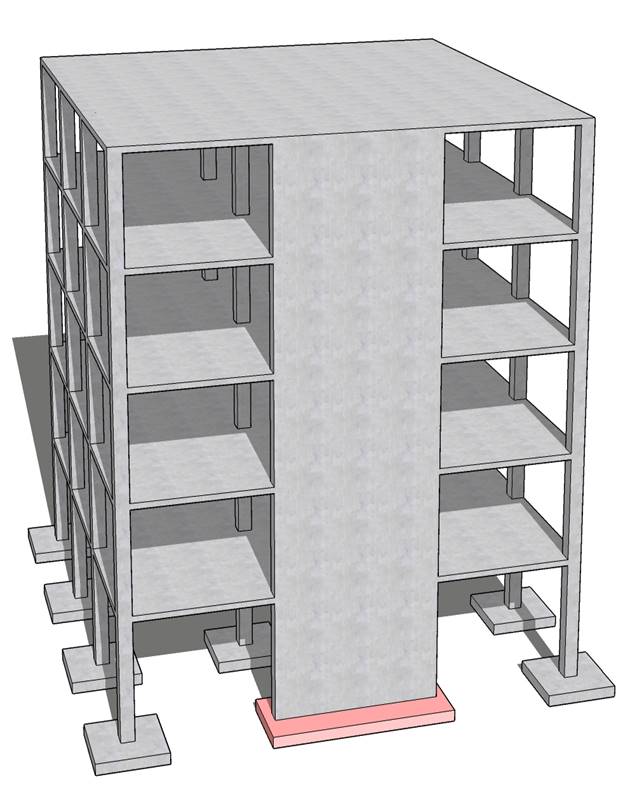


4
Shear walls are vertical structural elements that act as rigid barriers to resist lateral forces caused by earthquakes or wind. They are typically constructed using reinforced concrete or masonry and function like internal vertical cantilevers, transferring seismic loads safely to the foundation.
Main Types:
-
Reinforced Concrete (RC) Shear Walls
-
Most widely used type
-
High strength and ductility
-
Excellent performance under seismic loads
-
-
Masonry Shear Walls
-
Made from brick or concrete blocks
-
Require steel reinforcement to achieve adequate strength
-
Less ductile compared to RC shear walls
-
Seismic Analysis
Seismic analysis evaluates how structures respond to earthquake forces. It forms a core part of structural design, retrofitting, and earthquake engineering. Modern seismic design uses advanced computational tools and finite element modeling software to simulate real-time structural behavior under dynamic loading. Techniques such as response spectrum analysis and time-history analysis help predict displacement, base shear, and overall structural performance.
Earthquake-Resistant Structures
Earthquake-resistant structures are designed to withstand the strongest expected seismic events in a region without collapsing. While complete immunity to damage is impossible, the primary goal is to:
-
Prevent collapse
-
Protect human life
-
Maintain structural integrity
-
Limit functional damage during moderate earthquakes
Building codes require that structures endure maximum probable seismic forces while ensuring safety and economic feasibility.
Objectives of the Research
The study aims to:
-
Design an earthquake-resistant G+12 building structure.
-
Analyze structural behavior with shear walls.
-
Compare cost-effectiveness between models with and without shear walls.
-
Evaluate parameters such as story displacement, shear force, overturning moment, story drift, and material quantity.
-
Perform seismic analysis considering dead load, live load, and seismic loads.
Literature Review Insights
Recent studies emphasize the importance of shear walls and advanced structural analysis tools like ETABS in improving seismic performance.
-
Research shows that optimized shear wall placement significantly reduces lateral displacement and increases durability.
-
Buildings with structural irregularities (plan or vertical) are more vulnerable to seismic damage.
-
Studies comparing bare frames and shear-wall-integrated systems confirm that shear walls enhance stiffness, reduce drift, and improve overall seismic response.
-
Ignoring infill walls may lead to underestimation of base shear, increasing collapse risk.
-
Comparative studies for G+4, G+7, and G+12 buildings indicate improved seismic performance when shear walls or bracing systems are incorporated.
Overall, prior research supports the integration of shear walls to create safer and more resilient buildings in earthquake-prone areas.
Methodology
The study follows these steps:
-
Model a G+12 (13-story) structure.
-
Assign fixed supports at the base in X, Y, and Z directions.
-
Define beam (200×350 mm) and column (200×500 mm) sections.
-
Introduce shear walls in one model for comparison.
-
Apply loading conditions (dead load, live load, seismic load – Zone II, medium soil).
-
Perform structural analysis for various load combinations.
Two models are compared:
-
Model I: Without shear wall
-
Model II: With shear wall
Problem Statement
The study focuses on analyzing a G+12 multi-story structure under seismic conditions to evaluate the effectiveness of shear walls. The comparison is based on key seismic performance parameters such as story displacement, base shear, overturning moment, and story drift to determine structural safety and cost efficiency.
Conclusion
1) The comparison of story displacements for all three structural systems shows a clear improvement in lateral stiffness when shear walls are included. The model with shear wall and diaphragm consistently records the lowest displacement at every level, while the model without shear walls and diaphragm exhibits the highest values throughout the height. In contrast, the diaphragm-only model shows displacement values close to the shear-wall case but remains slightly higher at most stories. 2) The comparison of story drift for all three structural systems clearly indicates the advantage of incorporating shear walls in enhancing lateral stability. The model with shear walls consistently shows the lowest drift values across the height, while the structure without shear walls and diaphragm records the maximum drift at almost every level. 3) The comparison of story shear for all three structural systems highlights a strong improvement in lateral force resistance when shear walls are used. The structure with shear walls and diaphragm consistently shows the highest positive shear values, indicating better stability against lateral loads. The diaphragm-only model follows closely with slightly lower values at each level. 4) The comparison of overturning moments for all three structural configurations clearly demonstrates the effectiveness of shear walls in enhancing the building’s resistance against lateral overturning forces. The model with shear walls consistently exhibits the highest overturning moments at every level, followed closely by the diaphragm-only model with a slight reduction. In contrast, the structure without shear walls and diaphragm shows drastically lower moment values across the height. 5) The comparison of material quantity for all three structural systems highlights the efficiency achieved by incorporating shear walls. The model with shear wall and diaphragm consistently requires the least quantity of material, indicating better load distribution and structural optimization. In contrast, the model without shear wall and diaphragm shows the highest material requirement, reflecting reduced efficiency and greater demand to resist loads. 6) The cost comparison of all three structural systems clearly highlights the economic benefit of incorporating shear walls. The model without shear wall and diaphragm results in the highest construction cost, whereas the structure with shear wall and diaphragm requires the least cost due to reduced reinforcement demand.
References
[1] P. Sai Kumar Reddy, P P Guptha[ANALYSIS AND DESIGN OF SHEARWALLS FOR EARTH QUAKE RESISTANT BUILDINGS USING ETABS],International Journal of Engineering Science and Advanced Technology (IJESAT), MAY 2025 [2] Amit Chauhan, Murlidhar Chourasia, [Analysis of a Structure Under Diaphragm Irregularities],International Journal of Scientific Research in Civil Engineering, 2024 [3] B S Shamana , K C Manu and C Madhushree,[Comparative Seismic Analysis of Regular and Irregular Multistorey Structures with and without Bracings and Shear wall ],CTCS-2023 [4] Mitali Shelke, Suraj Marchande, Jay Bari, Sumit Malkar and Ajmal shaikh, [Comparative Analysis for with & Without Elastomeric Base Isolated Structure Using E-Tabs], Journal Publication of International Research for Engineering and Management (JOIREM) Volume: 04 Issue: 10 | may-2022. [5] Cem Yenidogan, [Earthquake-Resilient Design of Seismically Isolated Buildings: A Review of Technology], MDPI, 2021 [6] Jadhav Nachiket S., Shelke Nagesh L. and Deosarkar Manoj U, [Study of Seismic Analysis of Structure using Bracing, Damper, Base Isolation by Time History Method], International Research Journal of Engineering and Technology (IRJET), Volume: 07 Issue: 07, July 2020, ISSN: 2395-0056 [7] Ayuddin, [global structural analysis of high-rise hospital building using earthquake resistant design approach], SINERGI Vol. 24, No. 2, February 2020 [8] K. Surender Kumar , N. Lingeshwaran , Syed Hamim Jeelani, [Analysis of residential building with STAAD. Pro & ETABS], Elsevier, 2020 [9] Raja Gowhar, Nitin Mehta, [EARTHQUAKE RESISTANT DESIGN OF MULTISTOREY BUILDING], International research Journal of Engineering & Technology, Vol. 6 Issue 5, 2019. [10] Akash kumar, Er. Kundan kulbhushan, [design of earthquake resistant structure of multi-story rcc building], International Research Journal of Engineering and Technology, Volume: 06 Issue: 05, May 2019
Copyright
Copyright © 2026 Yash Mehra, Abhay Kumar Jha. This is an open access article distributed under the Creative Commons Attribution License, which permits unrestricted use, distribution, and reproduction in any medium, provided the original work is properly cited.

Download Paper
Paper Id : IJRASET77582
Publish Date : 2026-02-19
ISSN : 2321-9653
Publisher Name : IJRASET
DOI Link : Click Here
 Submit Paper Online