

Ijraset Journal For Research in Applied Science and Engineering Technology
UAV Based Smart Monitoring of Distribution Lines
Authors: Dr. Jyoti Sathe, Astha Bhaware , Megha Undirwade, Tejaswini Warghane, Piyush Patil, Sahil Nagpure
DOI Link: https://doi.org/10.22214/ijraset.2026.85287
Certificate: View Certificate
Abstract
Electrical distribution lines are essential components of the power system and are continuously exposed to electrical loading, temperature variations, wind, rain, pollution, vegetation, mechanical stress and ageing of components. Conventional inspection methods generally depend on manual patrolling and visual examination, which can be time-consuming and may expose maintenance personnel to electrical and environmental hazards. This paper presents a UAV-based distribution-line monitoring approach that combines aerial inspection with electrical, thermal, visual and positional information. The proposed system uses a UAV platform carrying a camera, a clamp-type current measurement arrangement, a temperature sensor, an ESP32-based data acquisition unit and GPS information. During inspection, the current and temperature of the monitored line section are acquired, while the camera captures images or video of conductors, insulators, poles, joints and other components. GPS information is recorded to associate the inspection observations with their geographical location.The collected data are stored and Measured values can be compared with reference or normal-condition data, while visual information is examined for visible abnormalities such as corrosion, damaged conductors, defective insulators, loose connections and other physical defects. The proposed system provides a systematic foundation for safer and faster preliminary distribution-line inspection. It can reduce the need for continuous manual patrolling, improve fault localization and support preventive maintenance.
Introduction
Electrical distribution networks are essential for supplying electricity to residential, commercial, agricultural, and industrial consumers. However, overhead distribution lines are exposed to environmental and operational factors such as excessive electrical loading, temperature variations, wind, rain, corrosion, vegetation growth, and equipment ageing. Traditional manual inspection is time-consuming, costly, and may expose maintenance personnel to electrical and environmental hazards. Therefore, UAV-based monitoring has emerged as a promising solution for safer and more efficient power-line inspection.
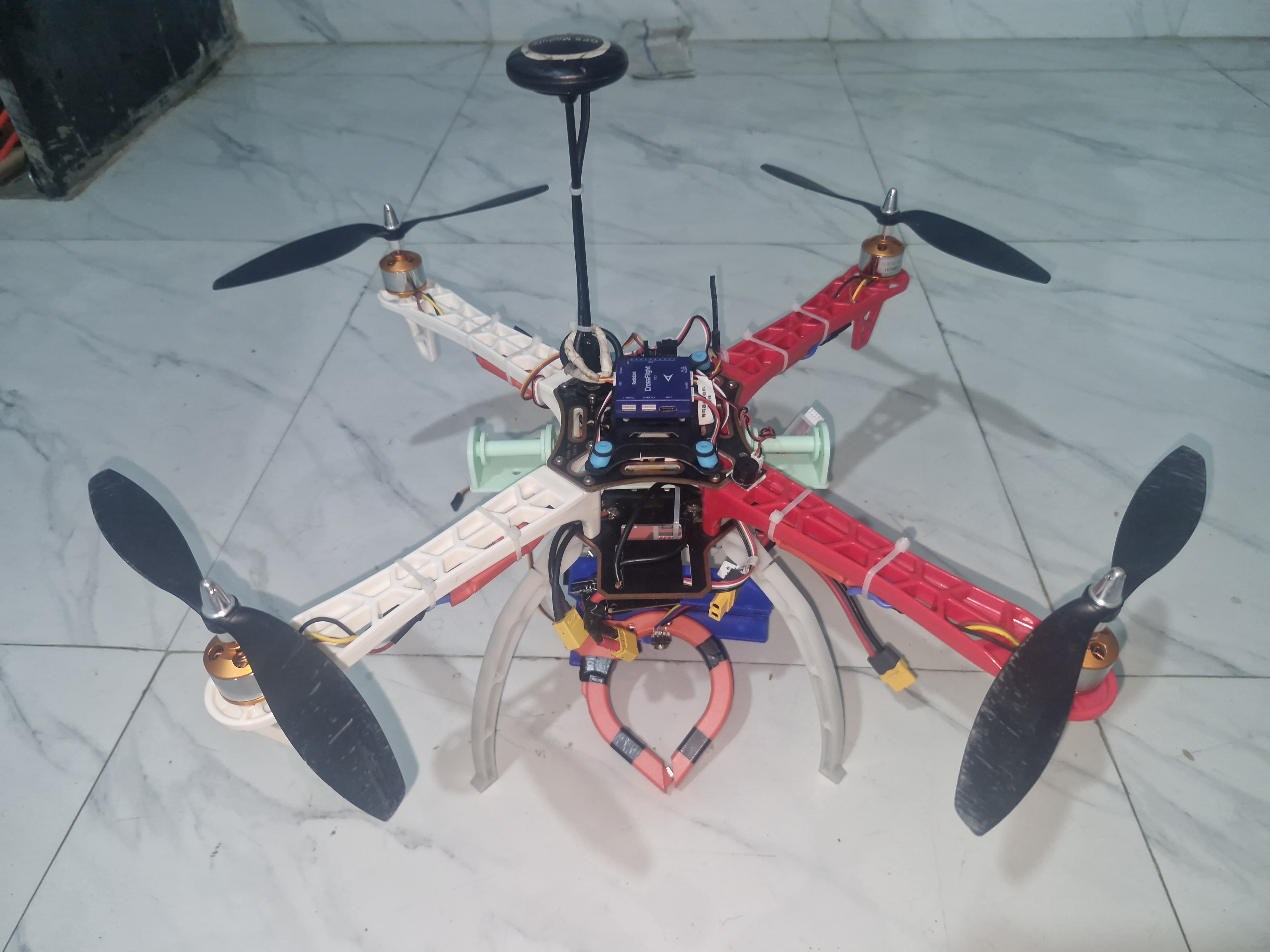
The proposed system uses an Unmanned Aerial Vehicle (UAV) equipped with a camera, current-measuring clamp meter, temperature sensor, and GPS module to monitor electrical distribution lines. The camera captures images and videos of conductors and associated components, the current-measuring device monitors electrical loading, and the temperature sensor identifies abnormal heating. The GPS module records the location of potential faults, allowing the collected data to be transmitted to a ground station or stored for further analysis. This integrated approach supports early fault detection and timely maintenance, helping reduce equipment failures and prolonged power outages.
The problem addressed by this research is the inefficiency and safety risks associated with conventional inspection methods. The scope of the work focuses on developing a UAV-based monitoring system that combines visual, electrical, thermal, and location-based information to improve inspection speed, safety, and reliability while reducing dependence on manual inspection.
The literature survey highlights advancements in UAV-based power-line inspection, including image processing, deep learning, object detection, satellite-ground communication, and digital twin technologies. Previous studies demonstrate the potential of drones to identify damaged components, detect power lines in images, improve inspection efficiency, manage vegetation risks, and optimize flight routes. These developments provide a foundation for integrating multiple monitoring techniques into a single inspection system.
The proposed system architecture consists of three main sections:
1. UAV platform: Uses a Cross Flight V1 flight controller, NEO-M8N GPS module, Li-Po battery, battery elimination circuit (BEC), and power module to provide flight control, positioning, and power supply.
2. Command and control system: Supports manual operation through an RC transmitter and autonomous waypoint missions planned using Mission Planner. Flight operations include take-off, waypoint navigation, payload actions, return, and landing.
3. Payload drop mechanism: Uses a servo motor, pulley system, and payload line to raise or lower the sensor payload and position it near the conductor for monitoring.
In conclusion, the proposed UAV-based distribution-line monitoring system aims to provide a safer, faster, and more systematic alternative to conventional inspection. By integrating visual inspection, current measurement, temperature monitoring, and GPS-based fault localization, the system can assist maintenance personnel in identifying abnormal conditions and carrying out corrective actions promptly, thereby improving the operational reliability and maintenance efficiency of electrical distribution networks.
Conclusion
The proposed UAV-based distribution-line monitoring system provides a safer and more efficient alternative to conventional manual inspection. By using a UAV equipped with a camera, current-measuring clamp meter, temperature sensor, and GPS module, important information about the condition of distribution lines can be collected remotely. The system can help identify abnormal conditions such as overcurrent, excessive temperature rise, conductor damage, and other visible defects, while GPS helps in locating the affected section. The use of UAV technology can reduce inspection time, minimize human exposure to electrical hazards, and support timely maintenance. Overall, the proposed approach can contribute to improving the reliability, safety, and efficiency of distribution-line monitoring. AI-based fault detection – AI/ML can be integrated to automatically detect and classify different distribution-line faults. Cloud-based data storage – Inspection data can be stored on cloud platforms for future analysis and maintenance records. Advanced image processing – Computer vision can be used to automatically identify cracks, damaged conductors, broken insulators, corrosion, and other physical defects. Obstacle avoidance – Advanced sensors such as LiDAR or ultrasonic sensors can be incorporated to improve safe UAV operation near electrical infrastructure.
References
[1] An Advanced Unmanned Aerial Vehicle (UAV) Approach via Learning-Based Control for OverheadPower Line Monitoring: A Comprehensive Review IEEE Access, 2021, DOI: 10.1109/ACCESS.2021.3110159 [2] Power Transmission Line Inspections: Methods, Challenges, Current Status and Usage of Unmanned Aerial Systems DOI:10.1007/s10846-024-02061 [3] Monitoring Power Lines and Vegetation Risks: From Conventional Method to Digital Twin, IEEE Access 2025 DOI: 10.1109/ACCESS.2025.3623468. [4] An Improved Lightweight RT-DETR Algorithm for High-Voltage Transmission Line Inspection, IEEE Access 2025 DOI: 10.1109/ACCESS.2025.3625122. [5] UAV Inspection Algorithm for Power Transmission and Distribution Lines Based on Satellite-Ground Fusion Network, IEEE AEECA 2024 DOI: 10.1109/AEECA62331.2024.00063. [6] Intelligent Monitoring and Inspection of Power Line Components Powered by UAVs and Deep Learning , Van Nhan Nguyen, Robert Jenssen, Davide Roverso , IEEE Power and Energy Technology Systems Journal,2019 [7] An UAV Inspection Method for Overhead Lines in Distribution Networks, Y. Nan 2025 IEEE 3rd International Conference on Sensors, Electronics and Computer Engineering (ICSECE 2025) DOI: 10.1109/ICSECE65727.2025.11256823 [8] A Drone Based Transmission Line Components Inspection System with Deep Learning Technique , Zahid Ali Siddiqui, Unsang Park , Energies, 2020
Copyright
Copyright © 2026 Dr. Jyoti Sathe, Astha Bhaware , Megha Undirwade, Tejaswini Warghane, Piyush Patil, Sahil Nagpure. This is an open access article distributed under the Creative Commons Attribution License, which permits unrestricted use, distribution, and reproduction in any medium, provided the original work is properly cited.
Download Paper
Paper Id : IJRASET85287
Publish Date : 2026-10-19
ISSN : 2321-9653
Publisher Name : IJRASET
DOI Link : Click Here
 Submit Paper Online